Drilingual Blog
DEUTSCH
Tango-Weltmeisterschaft 2026 – Wenn am Ende Hundertstel entscheiden, haben eigentlich alle gewonnen
Das Finale der Tango de Pista / Tango Salón Weltmeisterschaft 2026 in Buenos Aires ist getanzt. Natürlich braucht eine Weltmeisterschaft am Ende Ergebnisse, Namen, Punktzahlen und Platzierungen. Aber wenn am Ende nur noch Hundertstel darüber entscheiden, wer ganz oben steht, dann zeigt das für mich vor allem eines: Auf diesem Niveau haben eigentlich alle gewonnen.
Tango de Pista ist improvisiert. Es gibt keine Pflicht und keine identische Kür, die alle Paare gleich tanzen müssen. Jedes Paar reagiert im Moment auf die Musik, auf den Raum, auf die Verbindung innerhalb des Paares – und natürlich auch auf die anderen Paare auf der Fläche. Genau das macht diesen Tanz so lebendig und gleichzeitig seine Bewertung so schwierig.
Alle, die dort stehen, haben unendlich viel gearbeitet, trainiert und investiert. Natürlich kann deshalb jedes Paar im ersten Moment ein wenig enttäuscht sein, wenn es nicht selbst auf Platz eins landet. Aber wenn die Unterschiede so klein werden, dann geht es irgendwann nicht mehr darum, ob jemand grundsätzlich besser oder schlechter tanzt. Dann geht es um Nuancen, um Wahrnehmung, um den Moment – und manchmal eben auch um ein bisschen Glück.
Wie entstehen die Punktzahlen?
Auch die Art der Bewertung ist immer wieder Thema. Die höchste und die niedrigste Wertung der Jury werden aus der Berechnung genommen, und aus den verbleibenden Bewertungen entsteht der Durchschnitt.
Die Idee dahinter ist nachvollziehbar: Eine einzelne außergewöhnlich hohe oder außergewöhnlich niedrige Wertung soll nicht allein darüber entscheiden, wo ein Paar landet. Gleichzeitig wird natürlich auch über dieses Verfahren diskutiert, weil Extreme dadurch geglättet werden.
Noch wichtiger finde ich aber etwas anderes: Ein Paar kann in einem improvisierten Tanz nicht drei Minuten lang einen Höhepunkt nach dem anderen produzieren. Es gibt vielleicht ein, zwei oder drei ganz besondere Momente, in denen plötzlich alles zusammenkommt – Musik, Verbindung, Timing und Ausdruck.
Und genau darin liegt die enorme Schwierigkeit für die Jury. Während ein Paar vielleicht gerade etwas Außergewöhnliches tanzt, schaut ein Jurymitglied in diesem Augenblick auf ein anderes Paar. Das ist kein Fehler. Mehrere Paare tanzen gleichzeitig, und niemand kann jeden entscheidenden Augenblick sehen.
Der eine Juror sieht vielleicht genau diese wunderschöne Pause, einen besonderen musikalischen Akzent, eine außergewöhnliche Pisada oder eine sehr feine Bewegung im Körper. Ein anderer schaut in genau diesem Augenblick woanders hin.
Punktzahlen sind deshalb immer auch Momentaufnahmen. Sie zeigen nicht nur, was getanzt wurde, sondern auch, was in diesem Augenblick tatsächlich gesehen wurde.
Die Entscheidung der Jury muss man respektieren. Gleichzeitig darf man verstehen, warum nach einem solchen Abend darüber gesprochen und diskutiert wird.
Präsenz statt immer noch mehr
Für mich war an diesem Abend besonders sichtbar, wie wichtig Präsenz ist. Genau daran arbeite ich seit vielen Jahren auch mit meinen Klientinnen und Klienten: an Körperausdruck, innerer Haltung, Selbstbewusstsein und daran, wirklich im Moment zu sein.
Und etwas habe ich dabei immer wieder erlebt: Man muss manchmal überhaupt nicht an der Tangotechnik arbeiten, um einen Tango innerhalb weniger Minuten deutlich zu verändern.
Manchmal liegt das Entscheidende ganz woanders. Vielleicht in einem emotionalen Thema. Vielleicht in einem alten Muster. Vielleicht in der Frage, ob jemand sich überhaupt erlaubt, gesehen zu werden. Ob jemand sich erlaubt, Raum einzunehmen. Ob jemand wirklich glaubt: Ich darf hier sein. Ich darf gut sein. Ich darf sogar herausragend sein.
Dann verändert sich plötzlich die Haltung. Der Blick. Die Atmung. Die Art, wie jemand einen Fuß setzt. Wie jemand wartet. Wie jemand den Partner wahrnimmt.
Und innerhalb kürzester Zeit sieht der Tango anders aus, obwohl wir technisch vielleicht überhaupt nichts verändert haben.
Genau das finde ich so faszinierend. Denn es zeigt mir auch, dass diese Arbeit weit über den Tango hinausgeht. Wenn ein Mensch lernt, präsenter zu sein, sich nicht kleiner zu machen und sich selbst klarer zu zeigen, dann kann ihm das auch im sozialen Leben helfen, in Beziehungen, in Gesprächen und genauso im beruflichen Kontext.
Es geht also nicht nur darum, besser zu tanzen. Es geht darum, anders da zu sein.
Und genau deshalb arbeite ich mit meinen Klientinnen und Klienten häufig nicht zuerst an einem neuen Schritt oder an einer neuen Figur, sondern an Mindset, emotionalen Themen, Präsenz und Selbstbewusstsein.
Denn oft ist die größere Kunst eben nicht, noch mehr zu machen, sondern genau das Gegenteil: etwas wegzulassen, eine Pause zuzulassen, nicht sofort in die nächste Bewegung zu gehen und einen Moment einfach stehen zu lassen.
Auf diesem Niveau können alle unglaublich viel. Die Frage ist irgendwann nicht mehr nur: Wer kann technisch am meisten?
Sondern: Wer ist wirklich da? Wer bleibt sichtbar? Wer hebt sich von den anderen ab, ohne lauter werden zu müssen?
Im Tango gibt es für solche Feinheiten wunderbare Begriffe. Die Cadencia beschreibt diese ganz eigene Art, wie sich ein Mensch durch die Musik bewegt, und die Pisada die Qualität, mit der ein Fuß gesetzt wird. Manchmal reicht ein einziger bewusst gesetzter Schritt oder eine Pause – und plötzlich erkennt man einen Tänzer wieder.
Für mich ist diese Präsenz gleichzeitig auch eine Art Outing – im besten Sinne des Wortes. Ein Paar zeigt sich. Es zeigt seine Art zu tanzen, sein eigenes Lebensgefühl und damit auch etwas von sich selbst.
Bis ein Paar an diesem Punkt angekommen ist, steckt darin nicht nur unglaublich viel Zeit, Arbeit und Investition. Oft steckt darin auch ein Ringen innerhalb des Paares: Was wollen wir eigentlich tanzen? Was ist unser gemeinsamer Ausdruck? Welche Richtung fühlt sich für uns beide richtig an?
Bis zwei Menschen wirklich eine gemeinsame Linie gefunden haben, können Jahre vergehen. Es braucht Training, Gespräche, Auseinandersetzung, Veränderung und immer wieder die Bereitschaft, sich selbst und den anderen neu wahrzunehmen.
Und irgendwann entsteht daraus etwas Eigenes.
Ein Paar gibt damit auch ein Statement ab: Das ist unser Tango. So fühlen wir ihn. So möchten wir ihn zeigen.
Dadurch wird nicht nur dieses eine Paar sichtbarer. Der Tango selbst bekommt durch solche Paare immer wieder ganz neue Facetten, weil jedes von ihnen sein eigenes Lebensgefühl beisteuert.
Und genau daraus entsteht auch Selbstbewusstsein. Nicht das laute Selbstbewusstsein, das etwas beweisen muss, sondern ein ruhiges Selbstverständnis. Man muss nichts darstellen. Man ist einfach da.
Vielleicht ist genau das eine der größten Qualitäten im Tango: nicht zeigen zu müssen, was man alles kann, sondern den Mut zu haben, einen Moment stehen zu lassen und ihn wirklich zu genießen.
Mut, sich zu zeigen
Und genau dafür braucht es Mut. Mut, sich zu zeigen, sich bewerten zu lassen, sich auf diese Fläche zu stellen – vor ein großes Publikum und vor eine erfahrene argentinische Jury.
Alle Paare, die dort standen, haben sich positioniert. Sie haben etwas riskiert, indem sie sichtbar geworden sind. Und allein dadurch haben sie bereits etwas gewonnen: Erfahrung, Präsenz, Sichtbarkeit – und vielleicht die Möglichkeit, Menschen zu inspirieren, die sie nicht einmal kannten.
Gerade diejenigen, die vielleicht mit ihrer Wertung hadern, sollten das nicht vergessen. Sie waren dort. Sie haben sich gezeigt.
Vielleicht saß irgendwo jemand im Publikum und dachte: Genau so möchte ich einmal tanzen.
Vielleicht sollte man sich nach so einem Wettbewerb deshalb nicht nur fragen: Welchen Platz habe ich belegt?
Sondern auch: Wen habe ich vielleicht berührt, ermutigt oder inspiriert? Wen habe ich durch meinen Mut und meine Persönlichkeit erreicht?
Das Risiko, nicht gesehen zu werden, ist immer da. Aber gesehen zu werden, kann alles verändern.
Deshalb ziehe ich vor all diesen Paaren meinen Hut.
Die Platzierungen
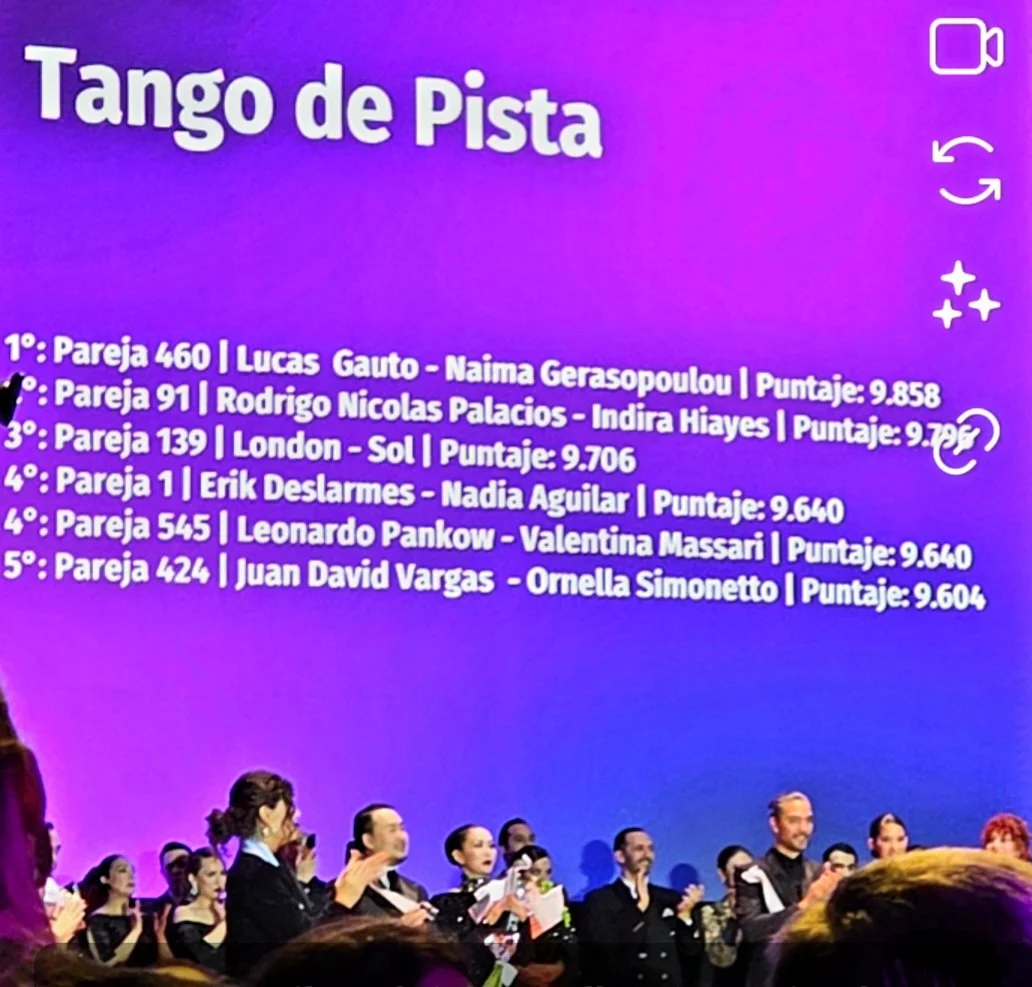
1. Platz – Naima Gerasopoulou & Lucas Gauto

Griechenland / Argentinien
9,858 Punkte
Naima und Lucas sind die neuen Weltmeister im Tango de Pista 2026. Für mich zeigen sie vor allem, dass Entwicklung nicht immer bedeutet, mehr zu machen. Es geht um Verfeinerung, Musikalität, Ruhe, Präzision, Verbindung und Präsenz.
Vielleicht ist genau das die wichtigste Lektion: Nicht mehr machen, sondern genauer werden.

2. Platz – Indira Hiayes & Rodrigo Palacios
Argentinien
9,796 Punkte
Mein ganz besonderer Glückwunsch gilt Indira und Rodrigo. Nicht nur wegen des herausragenden zweiten Platzes, sondern auch, weil ich Rodrigos Weg seit vielen Jahren miterleben durfte.
Eine Weltmeisterschaft ist nicht nur ein Ergebnis. Sie ist ein Meilenstein, der Sichtbarkeit schafft – und manchmal eine ganze Karriere verändert.
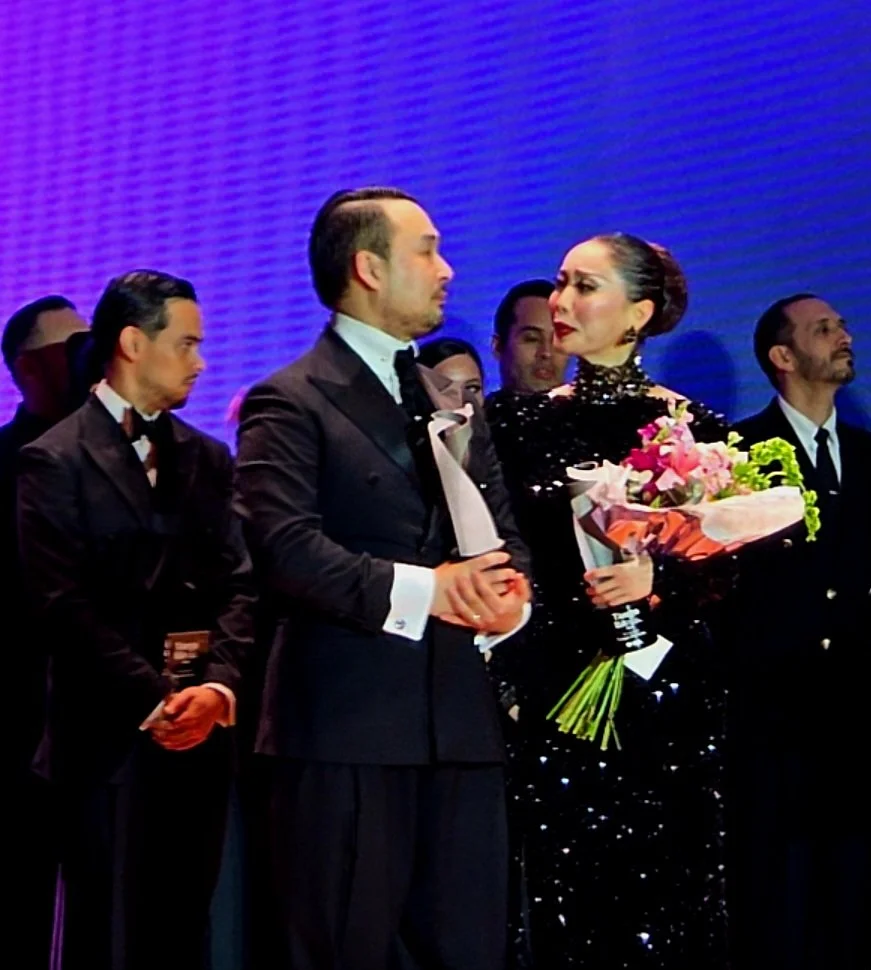
3. Platz – Solange Jung & London Hong
Südkorea
9,706 Punkte
Ich hatte das Glück, nach dem Wettbewerb kurz mit Sol und London zu sprechen. Sie wirkten beinahe zurückhaltend, als hätten sie Sorge, jemandem den dritten Platz weggenommen zu haben.
Dabei ist das Gegenteil der Fall: Sie haben viele Jahre gearbeitet, um genau diese Anerkennung zu bekommen.
Als Tänzer aus einer anderen Kultur in dieser zutiefst argentinischen Welt sichtbar zu werden, ist eine enorme Leistung.
Und auch hier zeigt sich, wie wichtig Selbstsicherheit im Tango ist. Wer mit dem Gefühl auf die Fläche geht, dass er dorthin gehört, dass er gut ist – vielleicht sogar der Beste sein darf –, strahlt etwas aus, das über Technik hinausgeht.
Da sind wir wieder beim Mindset.
Du musst dir erlauben, dein eigener Gewinner zu sein.
Und genau daran setzt auch meine Tango Pop Methode an. Nicht als weitere Technik, sondern als Arbeit an Präsenz, Haltung, emotionalen Themen, Selbstbewusstsein und dem Vertrauen in den eigenen Ausdruck.
Denn manchmal braucht ein Mensch keinen neuen Schritt. Er braucht die Erlaubnis, den Schritt, den er längst kann, auch wirklich zu zeigen.
4. Platz – Nadia Aguilar & Erik Deslarmes
9,640 Punkte
4. Platz – Valentina Massari & Leonardo Pankow
9,640 Punkte
Zwei Paare mit exakt derselben Punktzahl. Deutlicher kann man kaum sehen, wie eng die Weltspitze beieinanderliegt.
5. Platz – Ornella Simonetto & Juan David Vargas
9,604 Punkte
Ein Paar, das seit Jahren zur Spitze gehört und trotzdem immer wieder neuen Bewertungen und Vergleichen ausgesetzt ist.
Auch die Senioren haben ihren besonderen Moment
Neben der Hauptwertung gab es eine Auszeichnung für das beste Senior-Paar: Marcela Pilatti & Aldo Adrián Romero.
Ich finde diese Auszeichnung wunderschön, weil sie zeigt: Ausdruck, Musikalität, Präsenz und Entwicklung haben kein Verfallsdatum.
Vielleicht ist Tango sogar eine der wenigen Künste, in denen Lebenserfahrung nicht weniger, sondern mehr Ausdruck ermöglicht.
Milagros Amud – Tango besteht nicht nur aus Tanz
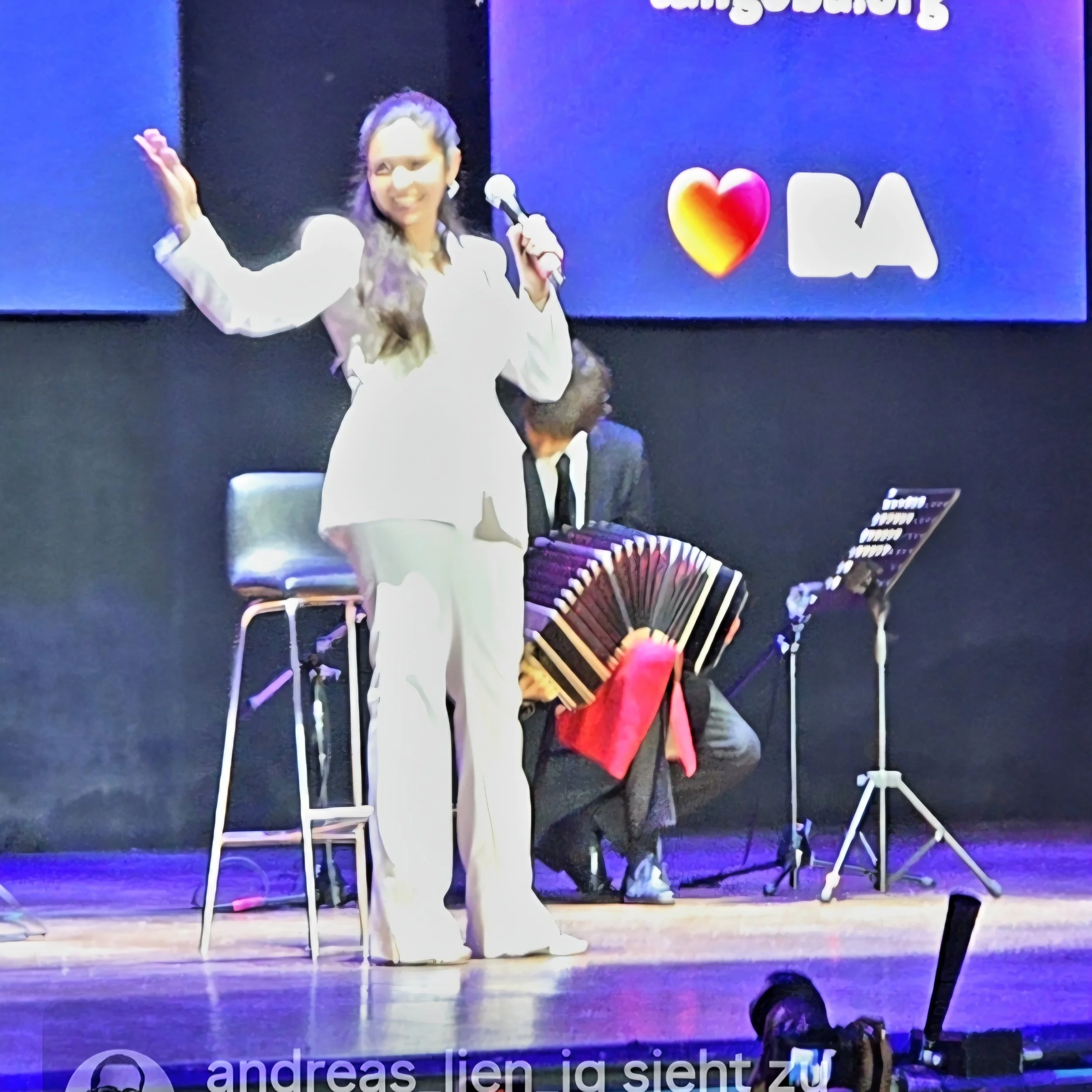
Mit Milagros Amud stand eine Sängerin auf der Bühne, die mit ihrem Trio die musikalische Seele des Tango in den Mittelpunkt stellte.
Tango ist nie nur Tanz. Tango ist Musik, Stimme, Poesie, Geschichte und Körper zugleich.
Und manchmal tut es gut, zwischen all den Punktzahlen einfach wieder zuzuhören.
Hinter den Punkten – worum es noch geht
Natürlich wird nach einer Weltmeisterschaft viel darüber gesprochen, wer an diesem Abend besser getanzt hat. Genau darum sollte es eigentlich gehen.
Gleichzeitig hört man in der Szene immer wieder Überlegungen, die darüber hinausgehen.
Welche Karriere hat ein Paar bereits? Welche Chancen eröffnet ein Titel? Ist ein Paar international längst etabliert, während ein anderes mit einem Titel zum ersten Mal überhaupt die Chance bekommt, wirklich international durchzustarten?
Manchmal fragt man sich, ob jemand diese Chance vielleicht weniger braucht als jemand anderes.
Ob so etwas je eine Rolle spielt, kann und will ich nicht beurteilen. Ich habe dafür keine Belege, und ich möchte niemandem etwas unterstellen.
Aber dass solche Fragen überhaupt entstehen, zeigt, wie viel Bedeutung ein Weltmeistertitel besitzt.
Ich fände es schade, wenn Überlegungen abseits der Fläche jemals den eigentlichen Kern des Wettbewerbs überlagern würden.
Am Ende sollte es um den Tanz gehen. Um das, was in diesen wenigen Minuten wirklich geschieht: Musikalität, Verbindung, Ausdruck und Präsenz.
Wer organisiert eigentlich eine solche Weltmeisterschaft – und warum?
Heute präsentiert Buenos Aires den Tango sehr bewusst als Teil seiner kulturellen Identität.
Ich erinnere mich noch an die frühen 2000er Jahre, als plötzlich Fragebögen kursierten, die damals viele irritierten: Wie viele Tangoschuhe kaufst du? Wie viel Kleidung? Wie lange bleibst du? Wie viel gibst du für Unterricht, Milongas, Hotels und Essen aus?
Im Rückblick wird klar, dass die Stadt begonnen hat zu begreifen, welchen kulturellen, aber auch wirtschaftlichen Wert der Tango hat.
Menschen aus aller Welt kommen nach Buenos Aires – wegen des Tango. Sie lernen, tanzen, kaufen, bleiben – oft für lange Zeit.
Wenn ein Weltmeistertitel Türen öffnet
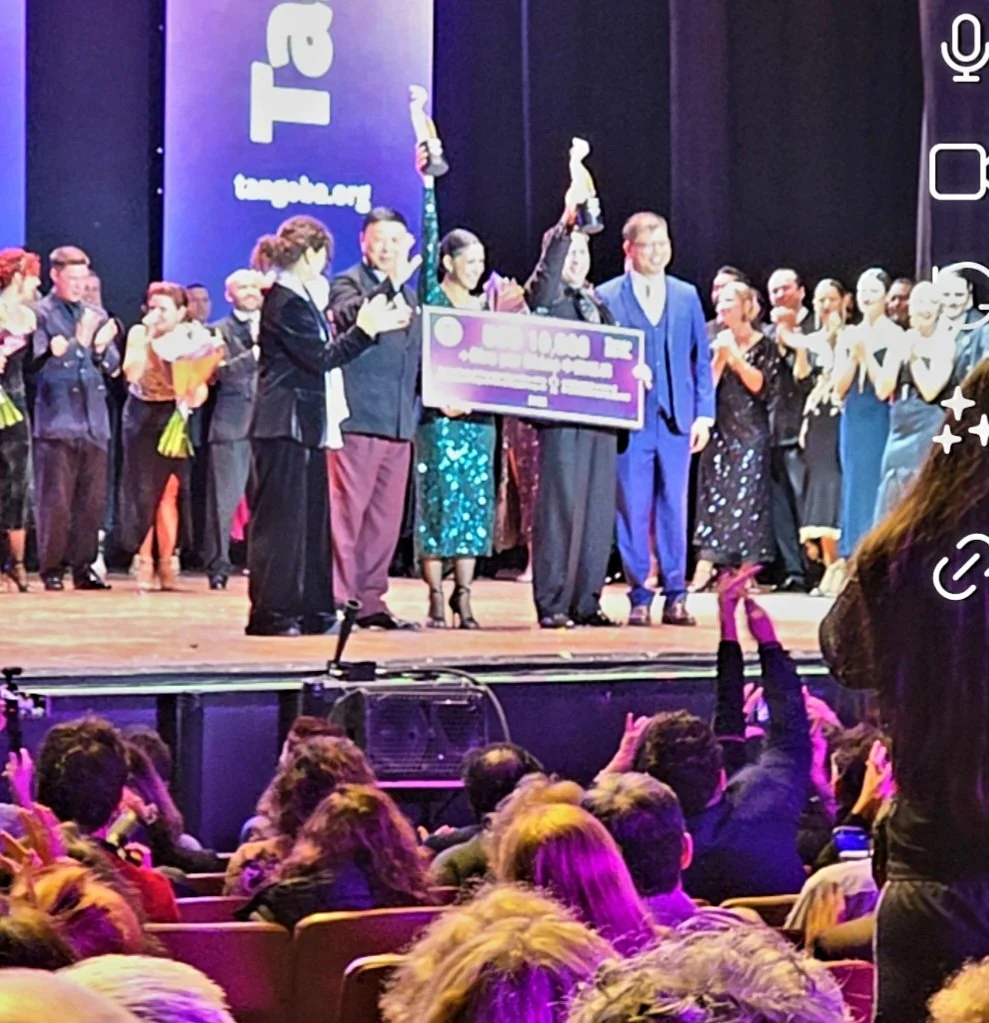
Bei der diesjährigen Preisvergabe wurde ein zusätzlicher Preis von 10.000 Dollar aus China angekündigt, verbunden mit einer künftigen Zusammenarbeit.
Das Besondere daran: Die Organisation wollte mit dem künftigen Weltmeister zusammenarbeiten, noch bevor überhaupt feststand, wer diesen Titel tragen würde.
Der Preis kam nicht von der Stadt Buenos Aires, sondern von außen.
Und genau das zeigt, wie international bedeutsam ein solcher Titel geworden ist.
Ein Weltmeistertitel ist nicht nur ein Pokal. Er kann Türen öffnen zu Tourneen, Festivals, Shows, Unterricht und kulturellem Austausch.
Aus eigener Erfahrung weiß ich, dass ein solcher Titel später etwas verändert – künstlerisch, wirtschaftlich, beruflich.
Häufig treten Paare nach einem Titel nicht noch einmal an, um ihn zu verteidigen, sondern nutzen ihn als Tür in einen neuen Abschnitt ihrer Laufbahn.
Neue Weltmeister bringen neue Impulse – so wie ein neuer Song in der Musik. Und trotzdem verlieren die Klassiker nie ihren Wert.
Meine persönliche Geschichte mit Rodrigo
Mit Rodrigo verbindet mich eine lange Geschichte.
Ich kenne ihn, seit er ein Kind war.
Er saß schon als kleiner Junge mit am Tisch, als ich meinen ersten Auftritt im Sunderland hatte.
Später habe ich seinen eigenen ersten Bühnenauftritt gesehen.
Und Anfang dieses Jahres hat Rodrigo meinen Sohn bei seinem ersten Auftritt in der Schweiz begleitet.
Für mich schließt sich hier ein Kreis.
Ein kleiner Junge von damals steht heute als Vizeweltmeister auf der Bühne von Buenos Aires.
Das berührt mich zutiefst.
Als die Punktzahlen veröffentlicht wurden
Nach der Show standen die Platzierungen fest. Später erschienen die detaillierten Punktzahlen online.
Da wurde vielen erst richtig bewusst, wie winzig die Abstände sind.
Dann wird klar: Es geht nicht um gut oder schlechter. Es geht um Nuancen.
Man entspannt sich. Man freut sich. Man feiert.
Viele sagen sich dann: Nächstes Jahr versuche ich es wieder.
Mit mehr Erfahrung, mehr Sicherheit, mehr Gelassenheit.
Aber nicht nur die Tänzer gewinnen
Auch das Publikum gewinnt.
Wer so viele außergewöhnliche Paare hintereinander sieht, schult automatisch seinen Blick.
Man beginnt herauszufinden: Was berührt mich eigentlich selbst? Welches Paar hätte ich gewählt? Wie möchte ich selbst tanzen?
Man sieht Nuancen, Pausen, eine bestimmte Pisada, eine Cadencia – und plötzlich denkt man: Genau so möchte ich einen Moment stehen lassen.
Auch das ist ein Sieg.
Und nach dem Wettbewerb bleiben die Menschen
Vielleicht waren die schönsten Momente sogar die nach der Entscheidung.
Da waren Tränen, Umarmungen, Paare, die einander aufgefangen, getröstet und beklatscht haben.
Für einen Moment verschwanden Plätze und Punktzahlen.
Man ging gemeinsam essen, tanzen, lachen.
Vielleicht dachten viele einfach nur: Ich war Teil dieses Abends.
Und das ist vielleicht die schönste Erkenntnis einer Weltmeisterschaft:
Die Punktzahlen stehen fest.
Die Erfahrung aber nimmt jeder mit sich.

Und vielleicht ist das genau der Moment, in dem wir uns daran erinnern, worum es im Tango wirklich geht: um Begegnung, um Verbindung, um Ausdruck, um Präsenz, um gemeinsam gelebte Zeit.
Nicht nur um Platzierungen.
Enrique M. Grahl
Buenos Aires – Tango World Championship 2026
ENGLISH
Tango World Championship 2026 – When Hundredths Decide, In a Way Everyone Has Won
The final of the 2026 Tango de Pista / Tango Salón World Championship in Buenos Aires is over. Of course, a World Championship needs results, names, scores and rankings. But when only hundredths of a point separate the couples at the very top, it shows something important: at this level, in a way, everyone has already won.
Tango de Pista is improvised. There is no compulsory routine and no identical choreography that every couple performs. Each couple responds in the moment to the music, to the space, to the connection within the partnership and, of course, to the other couples on the floor. This is precisely what makes tango so alive and at the same time so difficult to judge.
Everyone who steps onto this floor has invested years of work, training, energy and personal commitment. Of course disappointment can be part of the moment if the result is not first place. But once the distances become this small, the question is no longer simply who is better or worse. It becomes a question of nuances, perception, timing, that one special moment and sometimes a little bit of luck.
How are the scores created?
The judging system is constantly discussed. The highest and lowest scores are removed and the remaining marks are averaged.
The idea is understandable: one exceptionally high or low score should not determine the result by itself.
Yet there is something even more important. A couple cannot create highlight after highlight for three uninterrupted minutes in an improvised tango. There may be two or three moments in which everything suddenly comes together: music, connection, timing and expression.
While one couple is having exactly such a moment, a judge may be watching another couple. That is not a mistake; it is simply the reality of the task. Several couples are dancing simultaneously and nobody can see every decisive second.
Scores are therefore snapshots. They reflect not only what was danced, but also what happened to be seen in that particular moment.
The jury’s decision must be respected. At the same time, it is understandable why people talk and debate after an evening like this.
Presence instead of always doing more
What became particularly clear to me that evening was the importance of presence. This is exactly what I have worked on for many years with my clients: body language, inner attitude, self-confidence and the ability to genuinely remain in the moment.
I repeatedly experience that a tango can change within minutes without changing the technique at all.
Sometimes the decisive issue lies elsewhere. Perhaps in an emotional pattern. Perhaps in an old belief. Perhaps in whether someone permits themselves to be seen. Whether they allow themselves to take up space. Whether they truly believe: I am allowed to be here. I am allowed to be good. I may even allow myself to be outstanding.
Then posture changes. The eyes change. Breathing changes. The way someone places a foot changes. The way someone waits changes. The way someone perceives their partner changes.
And within a very short time, the tango looks different even though technically almost nothing may have changed.
This is exactly what fascinates me.
Because it also shows that this work reaches far beyond tango. When a person learns to be more present, not to make themselves smaller and to show themselves more clearly, that can also help socially, in relationships, in conversations and in professional life.
So it is not only about dancing better.
It is about being present differently.
And this is why, with my clients, I often do not begin with a new step or a new figure. I begin with mindset, emotional themes, presence and self-confidence.
Often the greater art is not to add more, but to leave something out, to allow a pause, not to rush immediately into the next movement and to let a moment simply remain.
At this level everyone can do an enormous amount technically. The question eventually becomes not only: Who can do the most?
But: Who is really there? Who remains visible? Who stands out without becoming louder?
Tango has wonderful words for these subtleties. Cadencia describes that unique way in which a person moves through the music, while Pisada describes the quality with which a foot is placed. Sometimes a single consciously placed step or a pause is enough and suddenly you recognize a dancer.
For me, presence is also a kind of revealing yourself. A couple shows itself. It shows how it dances, its own lived feeling, and therefore something of itself.
Until a couple reaches that point, there may be years of work, investment and searching behind it. Often there is also a struggle within the partnership: What do we actually want to dance? What is our shared expression? Which direction feels right to both of us?
It may take years before two people truly find a common line. It takes training, conversations, disagreements, change and a constant willingness to perceive oneself and the other person anew.
Eventually something unique emerges.
The couple gives a statement through its dance: This is our tango. This is how we feel it. This is how we want to show it.
And through these couples, tango itself keeps gaining new facets because every pair contributes its own lived experience.
From this, self-confidence also grows. Not loud confidence that needs to prove something, but a calm self-understanding.
You do not need to perform yourself.
You are simply there.
Perhaps that is one of the greatest qualities in tango: not having to show everything you can do, but having the courage to leave a moment standing and truly enjoy it.
The courage to be seen
And this takes courage. Courage to show yourself, to be judged, to step onto that floor in front of a large audience and an experienced Argentine jury.
Every couple standing there had positioned itself. They took a risk by becoming visible.
And by doing that alone, they already gained something: experience, presence, visibility and perhaps the opportunity to inspire people they may never meet.
Especially those who are disappointed by their result should not forget this.
They were there.
They showed themselves.
Perhaps someone in the audience looked at one particular couple and thought: That is how I want to dance.
Perhaps after a competition we should not only ask: What place did I get?
But also: Who did I touch, encourage or inspire? Who did I reach through my courage and my personality?
The risk of not being seen is always there. But being seen can change everything.
That is why I take my hat off to all of these couples.
The results
1st Place – Naima Gerasopoulou & Lucas Gauto
Greece / Argentina
9.858 points
Naima and Lucas are the new 2026 Tango de Pista World Champions. To me they show that development does not always mean doing more. It is about refinement, musicality, calmness, precision, connection and presence.
Perhaps that is the most important lesson: Do not do more. Become more precise.
2nd Place – Indira Hiayes & Rodrigo Palacios
Argentina
9.796 points
My very special congratulations go to Indira and Rodrigo. Not only because of this extraordinary second place, but because I have been able to witness Rodrigo’s path for many years.
A World Championship is not just a result. It is a milestone that creates visibility and sometimes changes an entire career.
3rd Place – Solange Jung & London Hong
South Korea
9.706 points
I had the chance to speak briefly with Sol and London after the competition. They seemed almost hesitant, as if they were worried that they had taken third place away from someone else.
But the opposite is true. They have worked for many years to receive this recognition.
To come from another culture and become visible at this level inside such a deeply Argentine world is an enormous achievement.
And once again, we see how important self-confidence is in tango. Someone who steps onto the floor with the feeling that they belong there, that they are good and perhaps even allowed to be the best, radiates something that goes far beyond technique.
This brings us back to mindset.
You have to allow yourself to be your own winner.
This is exactly where my Tango Pop Method begins. Not as another technique, but as work with presence, attitude, emotional themes, self-confidence and trust in one’s own expression.
Sometimes a person does not need a new step.
They need permission to truly show the step they already know.
4th Place – Nadia Aguilar & Erik Deslarmes
9.640 points
4th Place – Valentina Massari & Leonardo Pankow
9.640 points
Two couples with exactly the same score. It is difficult to demonstrate more clearly just how close the world’s best are to one another.
5th Place – Ornella Simonetto & Juan David Vargas
9.604 points
A couple that has belonged to the top level for years and is nevertheless repeatedly exposed to new judgments and comparisons.
The Senior Couple
There was also a special award for Marcela Pilatti and Aldo Adrián Romero as Best Senior Couple.
I find this award beautiful because it shows that expression, musicality, presence and development have no expiration date.
Perhaps tango is even one of the few arts in which life experience can create more expression, not less.
Milagros Amud – Tango is not only dance
Milagros Amud and her trio also brought the musical soul of tango to the stage.
Tango is never only dance.
It is music, voice, poetry, history and body.
And sometimes, between all the scores and rankings, it is good simply to listen again.
Beyond the scores
After a World Championship, people naturally talk about who danced better that evening. And that is exactly what it should be about.
At the same time, there are always conversations in the tango world that go beyond the dance itself.
What career has a couple already built? What opportunities can a title open? Is one couple already internationally established while another might get its first real chance to break through because of that title?
Sometimes people even ask whether one couple needs that opportunity less than another.
Whether such considerations ever play a role in an actual decision, I cannot and do not want to judge. I have no evidence and I do not want to accuse anyone.
But the fact that these questions arise at all shows how much significance a World Championship title carries.
I would find it unfortunate if anything beyond the dance floor were ever to overshadow the real core of the competition.
In the end it should be about the dance itself: musicality, connection, expression and presence.
Who organizes a World Championship like this – and why?
Today Buenos Aires consciously presents tango as part of its cultural identity.
I still remember the early 2000s, when questionnaires suddenly appeared at events asking visitors how many tango shoes they bought, how much clothing, how long they stayed and how much they spent on lessons, Milongas, hotels and food.
At the time many dancers found that strange.
Looking back, it becomes clear that the city was beginning to understand both the cultural and economic importance of tango.
People from all over the world come to Buenos Aires because of tango.
They learn, dance, buy, stay – often for a long time.
When a World Championship title opens doors
At this year’s award ceremony, an additional prize of 10,000 dollars from China was announced, connected to future collaboration.
What was particularly striking was that the organization wanted to work with the future World Champion before anyone even knew who that person would be.
The prize did not come from the city of Buenos Aires, but from outside.
And that shows how internationally significant such a title has become.
A World Championship title is not just a trophy. It can open doors to tours, festivals, performances, teaching and cultural exchange.
From my own experience, I know that such a title later changes something – artistically, economically and professionally.
Often couples do not return simply to defend the title, but use it as a door into a new chapter of their career.
New World Champions bring new impulses, like a new song in music.
And yet the classics never lose their value.
My personal story with Rodrigo
Rodrigo and I share a long history.
I have known him since he was a child.
He was already sitting at the table as a young boy when I danced my first performance at Sunderland.
Later I saw his own first stage appearance.
And earlier this year Rodrigo accompanied my son during his first performance in Switzerland.
For me, a circle closes here.
A little boy from back then now stands on the stage in Buenos Aires as Vice World Champion.
That moves me deeply.
When the scores were published
After the show the rankings were already known. Later the detailed scores were published online.
Only then did many people fully realize how tiny the differences really were.
Then it becomes clear: It is not about good and bad.
It is about nuances.
People relax. They celebrate. They enjoy the moment.
Many probably tell themselves: Next year I will try again.
With more experience, more confidence, more calmness.
The audience wins too
And the dancers are not the only ones who win.
The audience wins as well.
Watching so many extraordinary couples one after another automatically develops your own eye.
You begin to discover what moves you personally. Which couple would you have chosen? How do you want to dance?
You notice nuances, pauses, a particular Pisada, a Cadencia – and suddenly you think: That is how I want to leave a moment standing.
That too is a victory.
After the competition, the people remain
Perhaps some of the most beautiful moments came after the decision.
There were tears, embraces, couples holding one another, consoling and applauding one another.
For a moment the rankings and numbers disappeared.
People went out to eat, dance and laugh together.
Perhaps many simply thought: I was part of this evening.
And perhaps that is the most beautiful lesson of a World Championship:
The scores are fixed.
The experience stays with everyone.
And perhaps that is the moment when we remember what tango is really about: encounter, connection, expression, presence and time lived together.
Not only rankings.
Enrique M. Grahl
Buenos Aires – Tango World Championship 2026
ESPAÑOL
Mundial de Tango 2026 – Cuando deciden las centésimas, en realidad todos han ganado

Terminó la final del Mundial de Tango de Pista / Tango Salón 2026 en Buenos Aires. Por supuesto que un Mundial necesita resultados, nombres, puntajes y posiciones. Pero cuando solamente unas centésimas separan a las mejores parejas, para mí eso demuestra algo esencial: a este nivel, de alguna manera, todos ya han ganado.
El Tango de Pista es improvisado. No existe una rutina obligatoria ni una coreografía idéntica para todos. Cada pareja responde en el momento a la música, al espacio, a la conexión dentro de la pareja y también a las otras parejas en la pista. Eso hace que el tango esté vivo y, al mismo tiempo, que evaluarlo sea enormemente difícil.
Todos los que entran a esa pista han invertido años de trabajo, entrenamiento, energía y compromiso personal. Por supuesto que puede existir decepción si al final no llega el primer puesto. Pero cuando las diferencias son tan pequeñas, ya no se trata simplemente de quién es mejor o peor. Se trata de matices, percepción, timing, ese instante especial y, a veces, también de un poquito de suerte.
¿Cómo se forman los puntajes?
También se discute mucho sobre la forma de evaluar. La nota más alta y la más baja se eliminan, y con las restantes se forma el promedio.
La intención se entiende: una sola evaluación extremadamente alta o baja no debería decidir todo el resultado.
Sin embargo, para mí existe algo todavía más importante. Una pareja no puede producir un momento extraordinario tras otro durante tres minutos de tango improvisado. Tal vez haya dos o tres instantes en los que todo se une de repente: música, conexión, timing y expresión.
Mientras una pareja vive exactamente uno de esos momentos, un jurado puede estar mirando a otra pareja. Eso no es un error, sino la realidad de esta tarea. Varias parejas bailan simultáneamente y nadie puede observar cada segundo decisivo.
Por eso los puntajes también son fotografías de un instante. No muestran solamente lo que se bailó, sino aquello que llegó a ser visto en ese momento.
La decisión del jurado debe ser respetada. Al mismo tiempo, es comprensible que después de una noche así se hable y se discuta.
Presencia en lugar de hacer cada vez más
Algo que para mí se hizo especialmente visible esa noche fue la importancia de la presencia. Es exactamente lo que trabajo desde hace muchos años con mis clientes: expresión corporal, actitud interna, confianza en uno mismo y la capacidad de estar realmente en el momento.
Una y otra vez observo que un tango puede cambiar en pocos minutos sin modificar prácticamente nada de la técnica.
A veces el punto decisivo está en otro lugar.
Quizá en un tema emocional. Quizá en un patrón antiguo. Quizá en la pregunta de si una persona se permite ser vista. Si se permite ocupar espacio. Si realmente cree: Puedo estar aquí. Puedo ser bueno. Incluso puedo permitirme ser extraordinario.
Entonces cambia la postura. La mirada. La respiración. La manera de colocar un pie. La manera de esperar. La manera de percibir al compañero.
Y en muy poco tiempo el tango se ve diferente, aunque técnicamente quizá no haya cambiado casi nada.
Eso es precisamente lo que me fascina.
Porque también demuestra que este trabajo va mucho más allá del tango. Cuando una persona aprende a estar más presente, a no hacerse pequeña y a mostrarse con mayor claridad, eso puede ayudarle también en relaciones, conversaciones, situaciones sociales y en el ámbito profesional.
No se trata solamente de bailar mejor.
Se trata de estar de otra manera.
Por eso con mis clientes muchas veces no empiezo con un paso nuevo o una figura nueva, sino con mindset, temas emocionales, presencia y confianza en uno mismo.
Porque muchas veces el mayor arte no consiste en hacer más, sino exactamente lo contrario: quitar algo, permitir una pausa, no correr inmediatamente hacia el siguiente movimiento y dejar que un momento simplemente permanezca.
A este nivel todos saben muchísimo técnicamente. La pregunta deja de ser solamente: ¿Quién puede hacer más?
Y pasa a ser: ¿Quién está realmente presente? ¿Quién sigue siendo visible? ¿Quién se diferencia sin volverse más ruidoso?
En el tango existen palabras hermosas para estas sutilezas. La Cadencia describe esa manera tan propia en la que una persona se mueve dentro de la música, y la Pisada la calidad con la que se coloca un pie. A veces basta un solo paso consciente o una pausa para reconocer a un bailarín.
Para mí la presencia también es una forma de mostrarse. Una pareja se muestra. Muestra cómo baila, su propio sentimiento de vida y también algo de sí misma.
Hasta llegar a ese punto puede haber años de trabajo, búsqueda e inversión. Muchas veces también hay un verdadero proceso dentro de la pareja: ¿Qué queremos bailar? ¿Cuál es nuestra expresión común? ¿Qué dirección se siente correcta para los dos?
Pueden pasar años hasta que dos personas encuentren realmente una línea compartida. Hace falta entrenamiento, conversaciones, desacuerdos, cambios y la disposición constante de percibirse a uno mismo y al otro de una nueva manera.
Y finalmente aparece algo propio.
La pareja hace una declaración con su baile: Este es nuestro tango. Así lo sentimos. Así queremos mostrarlo.
Y gracias a parejas así, el tango mismo recibe nuevas facetas una y otra vez, porque cada pareja aporta su propio sentimiento de vida.
Y de ahí también nace la confianza en uno mismo. No una confianza ruidosa que necesita demostrar algo, sino una comprensión tranquila de uno mismo.
No hace falta representar nada.
Simplemente estás ahí.
Quizás esa sea una de las mayores cualidades del tango: no tener que mostrar todo lo que uno sabe hacer, sino tener el valor de dejar un momento quieto y disfrutarlo de verdad.
El valor de mostrarse
Y para todo eso hace falta valor. Valor para mostrarse, para ser evaluado, para entrar a esa pista frente a un gran público y un jurado argentino experimentado.
Todas las parejas que estuvieron allí se posicionaron. Arriesgaron algo al hacerse visibles.
Y solamente por eso ya ganaron algo: experiencia, presencia, visibilidad y quizá la posibilidad de inspirar a personas que nunca conocerán.
Especialmente quienes estén decepcionados con su resultado no deberían olvidarlo.
Estuvieron allí.
Se mostraron.
Quizá alguien en el público miró a una pareja y pensó: Así quiero bailar yo.
Tal vez después de una competencia no deberíamos preguntarnos solamente: ¿Qué puesto obtuve?
Sino también: ¿A quién toqué, animé o inspiré? ¿A quién llegué con mi valor y mi personalidad?
El riesgo de no ser visto siempre existe. Pero ser visto puede cambiarlo todo.
Por eso admiro profundamente a todas estas parejas.
Los resultados

1.er puesto – Naima Gerasopoulou & Lucas Gauto
Grecia / Argentina
9,858 puntos
Naima y Lucas son los nuevos campeones mundiales de Tango de Pista 2026. Para mí muestran que evolucionar no siempre significa hacer más. Se trata de refinar, de musicalidad, calma, precisión, conexión y presencia.
Quizás esa sea la lección más importante: No hacer más. Hacerlo con mayor precisión.
2.º puesto – Indira Hiayes & Rodrigo Palacios
Argentina
9,796 puntos
Mi felicitación más especial es para Indira y Rodrigo. No solamente por este extraordinario segundo puesto, sino también porque he podido acompañar el camino de Rodrigo durante muchos años.
Un Mundial no es solamente un resultado. Es un hito que crea visibilidad y a veces cambia una carrera entera.
3.er puesto – Solange Jung & London Hong
Corea del Sur
9,706 puntos
Tuve la oportunidad de hablar brevemente con Sol y London después de la competencia. Parecían casi tímidos, como si sintieran que le habían quitado el tercer puesto a otra pareja.
Pero la realidad es exactamente la contraria. Trabajaron durante muchos años para recibir este reconocimiento.
Llegar desde otra cultura y hacerse visible a este nivel dentro de un mundo tan profundamente argentino es una enorme conquista.
Y aquí aparece otra vez la importancia de la seguridad interior en el tango. Quien entra a la pista sintiendo que pertenece allí, que puede ser bueno y quizá incluso puede permitirse ser el mejor, transmite algo que va mucho más allá de la técnica.
Ahí volvemos al mindset.
Uno tiene que permitirse ser su propio ganador.
Exactamente ahí comienza también mi método Tango Pop. No como una técnica más, sino como un trabajo con la presencia, la actitud, los temas emocionales, la confianza en uno mismo y la confianza en la propia expresión.
A veces una persona no necesita un paso nuevo.
Necesita permiso para mostrar de verdad el paso que ya sabe.

4.º puesto – Nadia Aguilar & Erik Deslarmes
9,640 puntos
4.º puesto – Valentina Massari & Leonardo Pankow
9,640 puntos
Dos parejas con exactamente el mismo puntaje. Difícilmente se puede mostrar con mayor claridad lo cerca que está la élite mundial.
5.º puesto – Ornella Simonetto & Juan David Vargas
9,604 puntos
Una pareja que desde hace años forma parte de la élite y que, sin embargo, vuelve a estar expuesta una y otra vez a nuevas evaluaciones y comparaciones.
La pareja Senior
También hubo una distinción especial para Marcela Pilatti y Aldo Adrián Romero como Mejor Pareja Senior.
Me parece una distinción hermosa porque demuestra que la expresión, la musicalidad, la presencia y el desarrollo no tienen fecha de vencimiento.
Quizás el tango sea incluso una de las pocas artes en las que la experiencia de vida puede crear más expresión y no menos.
Milagros Amud – El tango no es solamente baile
Con Milagros Amud y su trío también estuvo presente en el escenario el alma musical del tango.
El tango nunca es solamente baile.
Es música, voz, poesía, historia y cuerpo.
Y a veces, entre tantos puntajes y posiciones, hace bien simplemente volver a escuchar.
Más allá de los puntajes
Después de un Mundial naturalmente se habla mucho de quién bailó mejor esa noche. Y en realidad de eso debería tratarse.
Al mismo tiempo, dentro del mundo del tango aparecen una y otra vez reflexiones que van más allá del baile.
¿Qué carrera tiene ya una pareja? ¿Qué oportunidades puede abrir un título? ¿Una pareja ya está establecida internacionalmente mientras otra, gracias al título, puede recibir por primera vez una verdadera oportunidad de crecer?
A veces incluso surge la pregunta de si una pareja necesita esa oportunidad menos que otra.
Si este tipo de pensamientos influyen alguna vez en una decisión concreta, no puedo ni quiero juzgarlo. No tengo pruebas y no quiero acusar a nadie.
Pero el simple hecho de que estas preguntas aparezcan demuestra cuánta importancia tiene hoy un título mundial.
Me parecería una pena que cualquier consideración fuera de la pista llegara a eclipsar alguna vez el verdadero núcleo de la competencia.
Al final debería tratarse del tango: musicalidad, conexión, expresión y presencia.
¿Quién organiza un Mundial así y por qué?
Hoy Buenos Aires presenta conscientemente el tango como parte de su identidad cultural.
Todavía recuerdo los primeros años de la década del 2000, cuando en algunos eventos comenzaron a circular cuestionarios que preguntaban cuántos zapatos de tango comprabas, cuánta ropa, cuánto tiempo permanecías en la ciudad y cuánto gastabas en clases, milongas, hoteles y comida.
A muchos bailarines les resultaba extraño en aquel momento.
Mirándolo con distancia, se entiende mejor que la ciudad empezaba a reconocer tanto el valor cultural como el valor económico del tango.
Personas de todo el mundo llegan a Buenos Aires por el tango.
Aprenden, bailan, compran, se quedan – a veces durante mucho tiempo.
Cuando un título mundial abre puertas
En la ceremonia de premiación de este año se anunció un premio adicional de 10.000 dólares proveniente de China, vinculado con una futura colaboración.
Lo especial fue que la organización quería trabajar con el futuro campeón mundial antes de que siquiera se supiera quién iba a ganar el título.
El premio no provenía de la ciudad de Buenos Aires, sino de afuera.
Y justamente eso muestra la importancia internacional que ha adquirido este título.
Un título mundial no es solamente una copa. Puede abrir puertas a giras, festivales, shows, enseñanza e intercambio cultural.
Por experiencia propia sé que un título así cambia cosas después – artística, económica y profesionalmente.
Muchas parejas no regresan simplemente para defender el título, sino que lo utilizan como una puerta hacia una nueva etapa de su carrera.
Los nuevos campeones aportan nuevos impulsos, como una canción nueva en la música.
Y, sin embargo, los clásicos nunca pierden su valor.
Mi historia personal con Rodrigo
Con Rodrigo me une una historia muy larga.
Lo conozco desde que era un niño.
Ya estaba sentado a la mesa de pequeño cuando yo tuve mi primer show en Sunderland.
Más adelante vi su propia primera presentación en el escenario.
Y a principios de este año Rodrigo acompañó a mi hijo en su primera presentación en Suiza.
Para mí aquí se cierra un círculo.
Aquel niño de entonces está hoy en el escenario de Buenos Aires como subcampeón mundial.
Eso me conmueve profundamente.
Cuando se publicaron los puntajes
Después del show las posiciones ya estaban definidas. Más tarde se publicaron los puntajes detallados.
Y recién entonces muchas personas comprendieron realmente lo pequeñas que eran las diferencias.
Entonces queda claro: no se trata de bueno o malo.
Se trata de matices.
La gente se relaja. Se alegra. Celebra.
Y probablemente muchos piensan: El año que viene lo intento otra vez.
Con más experiencia, más seguridad y más calma.
También gana el público
Y no solamente ganan los bailarines.
También gana el público.
Ver tantas parejas extraordinarias una detrás de otra desarrolla automáticamente nuestra propia mirada.
Uno empieza a descubrir qué le emociona personalmente. ¿Qué pareja habría elegido? ¿Cómo quiere bailar?
Uno observa matices, pausas, una determinada Pisada, una Cadencia – y de repente piensa: Así quiero aprender a dejar un momento quieto.
Eso también es una victoria.
Después de la competencia quedan las personas
Quizás algunos de los momentos más hermosos llegaron después de la decisión.
Hubo lágrimas, abrazos, parejas que se sostuvieron, se consolaron y se aplaudieron mutuamente.
Por un momento desaparecieron los puestos y los números.
La gente fue a comer, bailar y reír junta.
Quizás muchos simplemente pensaron: Formé parte de esta noche.
Y quizás esa sea la enseñanza más hermosa de un Mundial:
Los puntajes quedan establecidos.
La experiencia se la lleva cada uno consigo.
Y quizá sea justamente entonces cuando recordamos de qué se trata realmente el tango: encuentro, conexión, expresión, presencia y tiempo vivido juntos.
No solamente posiciones.
Enrique M. Grahl
Buenos Aires – Tango World Championship 2026
,